All images © by Roberto Piperno, owner of the domain. Write to romapip@quipo.it.

Notes:
Page revised in June 2026.
All images © by Roberto Piperno, owner of the domain. Write to romapip@quipo.it.
Notes:
Page revised in June 2026.
 Grottaferrata
It was his (of Cicero) custom in the opportunities of his leisure to take some friends with him into the country, where, instead of amusing
themselves with idle sports or feasts, their diversions were wholly speculative, tending to improve the mind and enlarge the understanding.
In this manner he now spent five days at his Tusculan villa in discussing with his friends the several questions just mentioned.
For, after employing the mornings in declaiming and rhetorical exercises, they used to retire in the afternoon into a gallery, called the Academy,
which he had built for the purpose of philosophical conferences, where, after the manner of the Greeks, he held a school, as they called it, and
invited the company to call for any subject that they desired to hear explained, which being proposed accordingly by some of the audience became
immediately the argument of that day's debate. These five conferences, or dialogues, he collected afterward into writing in the very words and
manner in which they really passed; and published them under the title of his Tusculan Disputations, from the name of the villa in which they
were held.
Introduction to the English version of Cicero's Tusculan Disputations by C. D. Yonge.

Abbazia di Grottaferrata seen from Monte d'Oro
Among the incidents of the evolution of human society in Latium none strikes the student as forcibly as the superposition of the Abbey of Grottaferrata on the Tusculanum of Cicero. I speak in a general sense, because it is not certain that the walls of reticulated masonry upon which the abbey rests are the same within which the orator held his "Tusculan" meetings, but for my purpose it is enough to take for granted that, as in ancient times Cicero's villa was the "attraction" of this district, so the Abbey of Grottaferrata constitutes now its most conspicuous landmark.
Rodolfo Lanciani - Wanderings in the Roman Campagna - 1909
It is uncertain whether the Abbey of Grottaferrata was built above Cicero's villa, but the fact that the ruins of a small aqueduct have been
identified at this site is consistent with a reference Cicero made about the water supply of his villa. The Renaissance walls which surround the abbey
were built making use of those which supported the terraces of the villa. The abbey is located between Marino and
Frascati, which is not far from ancient Tusculum.
When I asked the monks what vestiges they had discovered of Cicero there; "We have discovered (said they) the body of Benedict IX., which had been long supposed to lie in the clutches of the devil." But of Cicero?" - "Of Cicero we have only found an old trapezophoron". Cicero, who was extravagant in the article of tables, talks indeed of a trapezophoron which he wished to purchase; but whether he did so, and whether that was the very marble found here, are equally uncertain.
Joseph Forsyth - Remarks on Antiquities, Arts, and Letters in Italy in 1802-1803
Nineteen authors have attempted to find the exact location of the orator's villa. I myself took up the problem and my conjecture is that it must have stood on the Colle delle Ginestre, just above Grottaferrata. Lanciani

Museo Nazionale Romano: fountain which was found in 2010 at a Roman villa between Grottaferrata and Rome (IInd century AD - see a similar one at Tarragona): (above) Moon and Sun: (below) Mars and Mercury
Almost opposite the centre of the portico, and rather to the back, stands a summer-house, enclosing a small area shaded by four plane-trees, in the midst of which rises a marble fountain which gently plays upon the roots of the plane-trees and upon the grass-plots underneath them. (..) There is, besides, another room, which, being situate close to the nearest plane-tree, enjoys a constant shade and green. Its sides are encrusted with carved marble up to the ceiling, while above the marble a foliage is painted with birds among the branches, which has an effect altogether as agreeable as that of the carving, at the foot of which a little fountain, playing through several small pipes into a vase it encloses, produces a most pleasing murmur.
Pliny the Younger - Letters on the Tuscan Villa - LII - Transl. by William Melmoth
Cicero says that in the afternoons he used to retire with his friends into a gallery.
This has been identified in a portico which supported what today is the second cloister of the abbey; it could have been used by Cicero and his friends for walking while they were discussing philosophical matters, a practice introduced by the Greek Peripatetic philosophers; the portico was sheltered from cold north-eastern winds in winter and remained cool in summer. It might have housed a little fountain.

(left) "Aedicula Vetus" (Old Shrine) and behind it "Crypta Ferrata" (Iron Crypt); (right) modern statue of St. Nilus the Younger by Raffaele Zaccagnini (1904)
A visit to Grottaferrata is most attractive. Even the name of the place - the Iron Crypt - is mysterious. It appears for the first time in 1037. The learned monks have suggested its derivation from a railing inclosing a rustic chapel of the Madonna, from imaginary barracks of the first Legion Ferrata, from the iron-works at the waterfall of the Acqua Julia, or from the iron doors of the Iconostasis. None of these conjectures is satisfactory. Lanciani
The abbey is named after crypta ferrata, a funerary cell which was closed by two iron railings (It. ferro = iron). Assuming that the villa belonged to Cicero it could have been the tomb of his daughter Tullia. Together with Aedicula Vetus it was turned into an oratory in the Vth century and in 1004 it was donated to Nilus, a monk from Calabria, the southernmost
region of the Italian peninsula. According to tradition at that time Nilus was ninety-four years old, yet he was canonized as St. Nilus the Younger, to distinguish him from a Vth century Greek saint.

(left) S. Maria di Grottaferrata; (right) detail of a late XIXth century mosaic showing the church after the changes made by Cardinal Mario Mattei
Nilus had a vision of the Virgin Mary who told him to build a major shrine on the site of the small oratory. The church was completed in 1024 and it was subsequently modified several times. Many cardinals have associated their name with the construction of beautiful churches; unfortunately Cardinal Mario Mattei cannot be included among them. In 1848, in his capacity as Cardinal Bishop of Frascati, he decided to give the old church a Gothic style façade. Between 1911 and 1930 the church returned to its assumed medieval appearance, but this was done in an unconvincing manner.

Porta Speciosa (Beautiful Door) and details of its marble frame and of its wooden door
On stepping over the threshold of the sanctuary let us leave behind even historical controversy; peace and contentment are the only feelings which must be allowed to move our souls within these ancient cloisters. The Greek words of welcome engraved over the door of the church express the same sentiment: "O thou who enterest the house of God, leave behind thee all solicitous cares, so that thou mayst face thy Judge in peace!" Lanciani
At the time of Nilus, Calabria was a Byzantine possession and Nilus followed the rule established by St. Basil the Great, the father of
Eastern monasticism.
In line with the Byzantine tradition the church was preceded by a narthex which has retained its original decoration and in particular the door leading to the prayer hall.
A small inscription in Greek above the lintel quotes a sentence by St. Theodore of Studion.

(above) XIth century mosaic above Porta Speciosa depicting a "Deesis" (Christ in Majesty flanked by the Virgin Mary and St. John the Evangelist)
and a small Basilian monk (see a similar mosaic at Spoleto); (below) lintel of the portal
After a reign of eight months and nine days as Pope for the last time, Benedict IX., returned to his fortress of Tusculum in 1048. His end is unknown. If, as was said, he withdrew to the monastery of Grotta Ferrata, and, weary of life, from a heathen transformed himself into a saint, no one acquainted with the character of the times can doubt the possibility of the conversion. With Benedict ended the tyranny of the Counts of Tusculum. (..) While Colonna, Annibaldi, and Orsini took possession of the Tusculan side of the mountain, Grotta Ferrata, the Greek monastery of S. Nilus, flourished as one of the most important abbeys in Roman territory. The dominion of the Basilian monks extended over a great part of the mountains and over the Pontine marshes as far as Nettuno. They hunted to provide game for their table, and fished for pike, sturgeon, and lamprey.
Ferdinand Gregorovius - History of the city of Rome in the Middle Ages (1859-1872)
The source of the great wealth and of the extensive earthly possessions of the abbey is easily found in the fact that the abbey was the favorite halting-place of kings and emperors bent on pillaging and burning Rome, or trying to save her from pillagers and incendiaries. Under its roof Robert the Norman, Henry IV, Frederick I, Frederick II, and the Duke of Calabria had found shelter and good cheer, and had paid their debt of gratitude in territorial grants. Thus the abbey became in time almost a state within a state. With an income of one hundred thousand scudi a year (one thousand for each monk) they were able to come to the rescue of the S. P. Q. R. itself on more than one occasion. Lanciani
The abbey rapidly flourished in the XIth and XIIth centuries, but the conflict between the popes and the German emperors led the latter to seize and sack the abbey (in 1163 Frederick I and in 1230 Frederick II).
On the smiling slopes of Monte Cavo Frederick repeatedly erected his camp. His inquisitive glance detected two bronze statues, the figures of a man and of a cow, which served as the decorations of a well in the monastery. Both these antiquities, relics from ancient villas, he removed as spoils of war in order to embellish his Saracen colony of Luceria with Roman trophies. Gregorovius
The image used as background for this page shows a cow feeding a calf, the symbol of the abbey. According to tradition an ancient bronze
statue of a cow was taken away by the Muslim troops of Emperor Frederick II when they looted Grottaferrata.

Decorative band with the heraldic symbol (a chequered eagle) of the Conti di Segni (late XIIIth century)
Innocent III in 1198 and Gregory IX in 1227, both members of the family of the Conti di Segni, were elected Popes. Thanks to them this family acquired great influence and many other fiefdoms, including Poli. In the XIIIth century the abbey declined because of the foundation of new religious orders by St. Dominic and St. Francis and because of the conquest of Constantinople in 1204 by the Fourth Crusade which put an end to the remaining Byzantine influence in Italian political and religious matters.

(left) Vase for holy water (XIIth century - original at the museum); (right) Cosmati pavement, typical of many XIIth century churches of Rome, e.g. S. Benedetto in Piscinula
Pius II visited Grottaferrata on May 30, 1463. In the diary of the journey written by his master of ceremonies, the place is described as standing above Cicero's villa, between the villas of Lucullus and Marius. "Here dwell Greek monks with flowing beards who on the eve of Epiphany bless the water of the basin placed in the vestibule of the church, where it is kept for a whole year to be drunk, drop by drop, by people suffering from the ague." Lanciani
The Abbey had an aghiasma, a holy water, which was collected and blessed in a liturgical vase with unusual reliefs depicting fishermen and divers. Some churches of Constantinople were known for their holy water. The water could be that of a well (as at S. Maria in Via), but also that dropping from a cave as at Sumela.

XIth century mosaic above the apse portraying the Twelve Apostles at the sides of a throne
Of the ancient mosaics which decorated the interior only a Hetoimasia was not replaced by later frescoes or mosaics. Hetoimasia (ready/empty throne) is a Christian symbol for the Ascent to Heaven of Jesus Christ or his Divine Power. Although not being very common it can be seen at other locations in Italy where links with the Byzantine world were strong such as Ravenna and in the early mosaics of S. Maria Maggiore.
You may wish to see other Roman Golden Mosaics.
Eugenius IV made Bessarion of Trebizond a cardinal in 1439. He
acquired mastery of the Latin language, and Latinised himself, but the gravity of his manners and his
long beard betrayed the Greek. He was made
Commendatore of the Abbey of Grotta Ferrata,
where the convent of Basilians still endured, and to
this beautiful solitude he frequently retired. Gregorovius
At the conclave of 1455, following the death of the great Nicholas V, Bessarion was on the point of receiving a majority of the votes, when a ludicrous allusion by Cardinal Alain of Brittany to his long, flowing beard, typical of Eastern prelates, turned the election in favor of the Spaniard Callixtus III. Lanciani
Cardinal Bessarion visited all the Basilian monasteries in Italy and he reformed their rules to ensure they complied with the Roman Catholic Church doctrine, although retaining a typical Greek liturgy. In 1462 he became abbot commendatario (having supervision over the affairs of the abbey, without being a monk) of Grottaferrata and he brought the abbey back to its old importance. Changes were made at that time and in the following centuries to the interior of the church, but some medieval features such as the liturgical vase and the Cosmati pavement were not affected.

(left) Renaissance Gate; (centre) an oak, the heraldic symbol of the Della Rovere; (right) military symbols including (top) a pelta,
the shield of the Amazons (you may wish to see an Amazon with a pelta in a relief
in the Museum of Corinth)
At the death of Bessarion in 1472 Pope Sixtus IV appointed a new abbot and he chose his young nephew Cardinal Giuliano Della Rovere who promoted an enlargement of the abbey which included Palazzo del Commendatore, a new residence in Renaissance style for himself. Its entrance was framed by reliefs inspired by ancient Roman paintings discovered in those years at Domus Aurea and called candelabra (chandeliers) because of their vertical alignment.
When we think of a cloister, we do not expect to see such high columns and harmonious vaults as those designed by Giuliano da Sangallo for Cardinal Della Rovere. They resemble those created fifty years earlier by Filippo Brunelleschi at Spedale degl'Innocenti in Florence. Because Sangallo was primarily a military architect he was credited by some art historians with the construction of the fortress of Grottaferrata.

Fortifications of Grottaferrata
Our first resting place was the monastery of monks of the Greek order of Basilio, at Grotta Ferrata. Bristling with towers and surrounded with a ditch, it has more the air of a fortress than of a monastery; but its style of architecture is well suited to its situation, for its frowning aspect is the more impressive from its contrast with the sylvan region, thickly wooded with elms and planes, above which it rises.
George Stillman Hillard - Six Months in Italy in 1847-1848
In 1482 Cardinal Della Rovere commissioned Baccio Pontelli to design and build new state-of-the-art walls which could withstand the impact of cannon.
At that time he did not have anything to fear because his uncle was still living,
but he probably thought that the fortified abbey could provide him with a safe haven in the future. A few years later the Cardinal was assigned to the see of Ostia where he asked Baccio Pontelli to design S. Aurea, a church which shows a decoration similar to that of the Renaissance Gate at Grottaferrata, and a castle which is known as Castello di Giulio II, because in 1503 the Cardinal became
Pope Julius II.

A drawing on a wall of Palazzo del Commendatore (which today houses the Archaeological Museum) depicting the fortress, its artillery and a flag of the Colonna
Julian Rovere as provost of Grotta
Ferrata restored the entirely ruinous convent,
making it a fortress by the addition of walls and
towers. This convent stronghold still retains the
form given to it by Julian, as does the celebrated
fortress of Ostia. (..) On May 24, 1494, Alexander VI. wrote to Fabrizio Colonna and he promised
that he should remain in peaceful possession of Grottaferrata, which
Cardinal Julian had surrendered. (..) Fabrizio Colonna, Duke of Paliano, took the fortress by assault on September 18 1494 and planted the flags of France and of Cardinal Julian on its walls. (..) On September 21 1526 the foreign envoys were summoned to S. Angelo, and here Moncada drew up the following agreement: a four months' truce was concluded between Clement and Charles; the Pope recalled his troops from Lombardy, his fleet from Genoa; the Colonna, to whom a full pardon was granted, retired to Naples. In concluding this treaty, Clement, as one of his confidants openly avowed, had no intention of keeping it. (..) On the other hand the Colonna were angry with Moncada; they would have liked to storm the fortress, carry the Pope away a prisoner, and see Rome in revolt; they upbraided the Spaniard as a traitor who had been bribed. Their troops laden with spoils left the Baths of Diocletian, where they had been encamped, and withdrew to Grotta Ferrata on the morning of September 22. Gregorovius
The history of the abbey was not that of a peaceful retreat in the late XVth and early XVIth centuries.

Cappella Farnese: (left) altar; (right) ceiling with the coat of arms of Cardinal Odoardo Farnese
After cardinals Bessarione and Della Rovere, being the abbot of Grottaferrata became a highly regarded appointment. In 1589 Cardinal Odoardo Farnese, a distant relative of Pope Paul III, was appointed abbot commendatario of Grottaferrata. He was born in Parma and he protected a series of artists of the School of Bologna (the two towns are quite close). His palace in Rome was decorated by the Carracci, the leaders of the School of Bologna, whereas at Grottaferrata in 1610 he commissioned Domenichino, a pupil of the Carracci, a series of frescoes for a new chapel which adjoins the church, rather than being part of it.

(left) Fresco by il Domenichino in Cappella Farnese; (right) detail showing (from left to right at the sides of the horse) the painter himself,
Guido Reni and il Guercino
The best evidence of the influence that these charming retreats exercise on superior minds is to be found in Domenichino's experience. His home life was a hell, and yet, once within the shelter of the abbey, he could forget his sorrows so far as to be able to paint a whole set of masterpieces, showing a perfect balance of mind. Lanciani
The great attraction of this monastery consists in a series of seven frescoes by Domenichino, in the chapel; the subjects of which are taken from the legendary life of St. Nilus, its founder. So far as a hurried examination of these works enabled me to judge, they seemed of great merit, and not a jet below their high reputation. They do not beat down the mind with superhuman power, like the frescoes of Michael Angelo; or fill it with visions of celestial beauty, like those of Raphael. Domenichino was neither a giant nor a seraph. But these works at once delight the taste and satisfy the critical judgment. Hillard
(The fresco) depicts the interview of St. Nilus and
Otho III near Gaeta. Otho dressed in an embroidered mantle, has alighted from his charger, and extends his arms
to embrace the saint, who, with a countenance at once breathing affection and sanctity, humbly extends his arms towards the Emperor.
The saint is followed by other monks bearing a Cross and thurible; and the Emperor is attended by his soldiers and suit, amongst whom
Domenichino has painted himself clothed in green, and holding the bridle of the Emperor's horse; and his two friends Guido and Guercino,
the former leaning on the horse and the latter earnestly addressing Guido. (..) This large fresco is full of life and spirit.
Rev. Jeremiah Donovan - Rome Ancient and Modern - 1843
In the early XIXth century travellers came to Grottaferrata to see the frescoes by Domenichino: at that time this painter
and Guido (as Guido Reni was called) were
considered the last great Italian painters before the Decadence (i.e. the Baroque period) and in 1827 Stendhal wrote of fresques sublimes at Grottaferrata in his Promenades dans Rome. Later on in the XIXth century the admiration for Domenichino faded away (read Henry James' account of his
visit to Grottaferrata).

(left) Baroque altar; (right) the sacred image
The Barberini abbots have taken care to put an end to this antimonastic state of things by appropriating every possession of their proteges, - books, manuscripts, statues, pictures, precious vestments, and landed property. Lanciani
In 1627 Cardinal Francesco Barberini, nephew of Pope Urban VIII, was appointed abbot commendatario of Grottaferrata. In ca 1660 he commissioned Gian Lorenzo Bernini the design of an altar meant to house a medieval sacred image of Madre di Dio (Theotokos in Greek). Bernini designed the altar which was executed by Antonio Giorgetti, one of his most trusted assistants (you may wish to see other Baroque Angels).

Liturgical Museum: (left) Phelonion; (right) Omophorion
Grotta Ferrata is a large castellated convent of Basilian monks, called in Latin "Monasterium Cryptae Ferrata." (..) In the church-service of this convent a Greek version of the Roman ritual is used.
Sir William Gell - The topography of Rome and its vicinity - 1834
The Greek Rite which was brought to Grottaferrata by St. Nilus had lost its native character by the end of XIIth century, but it was restored by order of Pope Leo XIII in 1881. New vestments and liturgical objects replaced those of the Latin tradition. Most of them were bought in Greece and Russia. They are on display at a small museum near the statue of St. Nilus.
The phelonion is worn over the priest's other vestments and is equivalent to the chasuble of Latin tradition. Like the chasuble, the phelonion was originally a conical round vestment with a hole in the middle for the head, which fell to the feet on all sides. It was in use as early as the VIth century for priests, bishops, and also minor orders (see mosaics at the Euphrasian Basilica of Parenzo).
The omophorion is the symbol of a bishop's spiritual and ecclesiastical authority. It is a band of brocade decorated with four crosses and an eight-pointed star; it is worn about the neck and shoulders. By symbolizing the lost sheep that is found and carried on the Good Shepherd's shoulders, it signifies the bishop's pastoral role as the icon of Christ. All Eastern Orthodox bishops wear the omophorion (see mosaics at the Parecclesion of Fethiye Camii portraying saints who were bishops).

Liturgical Museum: (left) Antiminsion; (right) Dikirion
The antiminsion is a special corporal required to be on the altar in many Eastern Christian liturgical traditions. It was originally used as a portable version of an altar. It is a rectangular piece of cloth of either linen or silk, typically decorated with representations of the Descent of Christ from the Cross, the Four Evangelists, and inscriptions related to the Passion. In the Latin Churches an altar stone serves a similar function.
Dikirion and Trikirion are liturgical candlesticks used by bishops of the Byzantine Catholic Church to bless the clergy and the faithful. They represent the dual nature of Christ and the Holy Trinity. The bishop holds the trikirion in his right hand and the dikirion in his left and makes the sign of the cross with both. The candleholders are mounted at an angle so that the candles cross each other and are tied together with ribbons at the point of intersection.

Liturgical Museum: (above) (left) Reliquaries (XIXth century); (centre) Chalice (XVIIIth century - Latin rite); (right) Byzantine Mitre (XIXth century - made in Rome); (below) Ripidions
The ripidion is a ceremonial fan made of metal, round, having the iconographic likeness of a six-winged seraphim and is set on the end of a pole. Fans of carved, gilded, or painted wood are also found. Fans are usually made in pairs.

Grottaferrata: (left) Corso del Popolo, the main street of the town; (right) public park adjoining the Abbey
The shady walks and drives in the neighbourhood of the place and the building itself, with the celebrated pictures in fresco by Domenichino, cause Grotta Ferrata to be much frequented during the summer by strangers and artists from Frascati and Albano. Gell
It is true that modern swift means of locomotion have disturbed the solitude of which the villa-builders and the cenobites were so jealous; but by a mercy of fate the gardens of the abbey are still free from any annoying contact. And if, while sitting under the shade of the grove planted by St. Nilus, the faint echo of the engineer's whistle reaches our ear, we feel tempted to repeat in their blunt selfishness the verses of the poet (Lucretius - De Rerum Natura): -
"Suave, mari magno turbantibus aequora ventis, E terra magnum alterius spectare laborem!"(It is pleasant to watch from the land the great struggle of someone else in a sea rendered great by turbulent winds). Lanciani
Move to page two - The Archaeological Museum.
Next step in your tour of the Environs of Rome: Marino
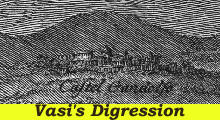
Excerpts from Giuseppe Vasi 1761 Itinerary related to Grottaferrata:
Giuseppe Vasi
|